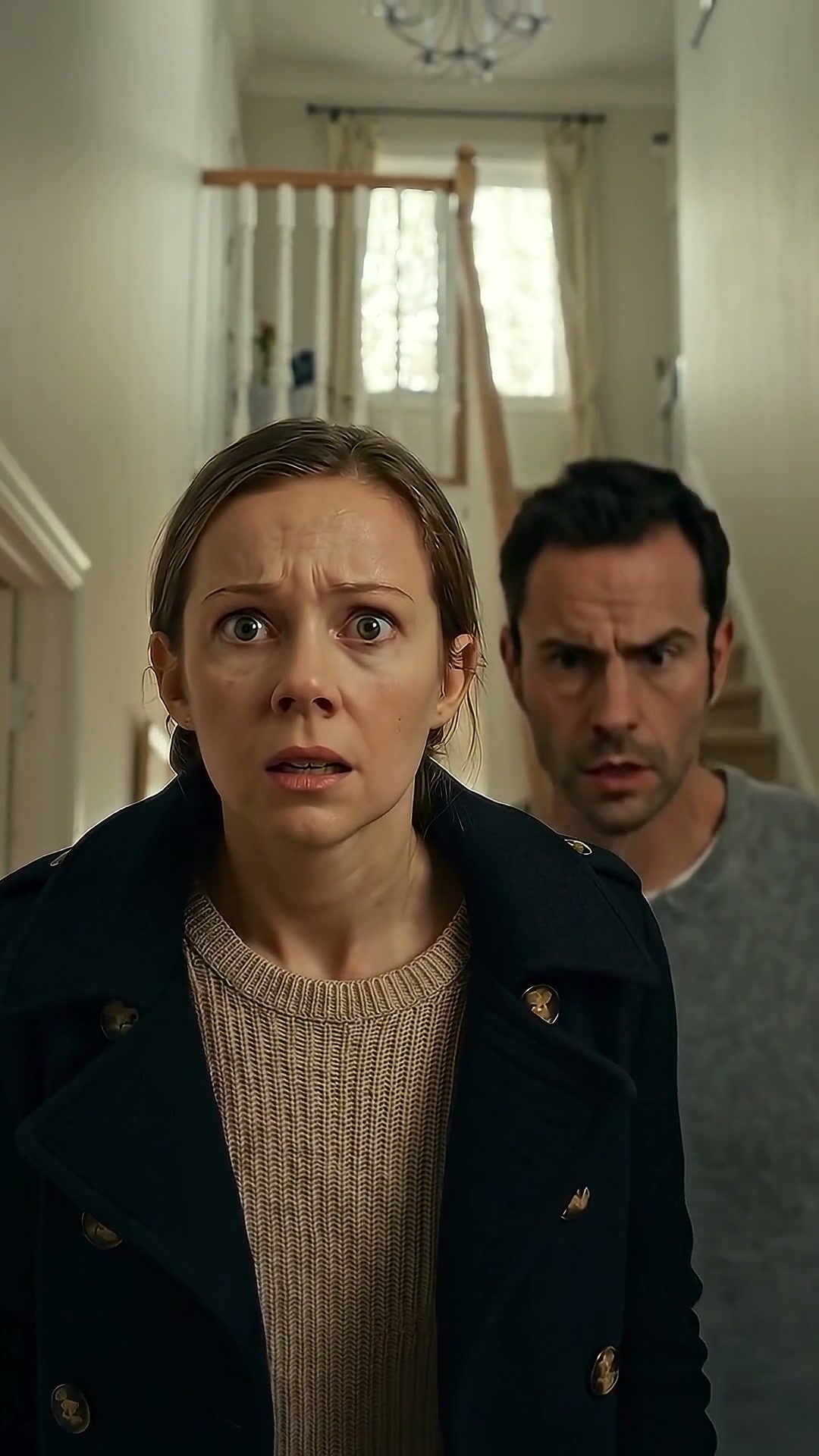
but I had never surrendered my keys.
Peter used the adjacent company yard, and the farmhouse had remained our family home between postings.
Now a contractor’s van was parked beside my father’s lilac bushes.
Inside, Peter and Celia stood in the kitchen with a man holding a measuring tape.
A set of glossy redevelopment plans lay across my mother’s oak table.
They had drawn a parking lot over the vegetable garden.
“Put the plans away,” I said to the contractor.
“This property is under a disputed transfer.
My attorney will be contacting your employer.”
The man folded his tape measure and left, grateful for an excuse not to stand between us.
Peter looked older than he had in the company photographs.
He stepped toward me.
“Miri, this isn’t what you think.”
“Stop calling me that.”
Celia stood near the pantry with my compass resting against her throat.
Up close I could see that the chain was not the one my soldiers had purchased.
Someone had replaced it with a heavier gold chain.
She touched it when she saw me look.
“Peter said you were separated,” she said.
“Did he also say I had donated my mother’s house?”
She looked toward him.
“You told me she’d agreed.”
“You signed as me,” I said.
“There is a notarized deed with my name on it.”
Celia’s face tightened.
“He said it was a temporary authorization, just to satisfy the buyer’s checklist.
He said nobody would file it until you approved.”
Peter snapped, “Celia, stop talking.”
That command told me more than their rehearsed explanations.
Celia knew the paperwork wasn’t genuine.
She had believed, or chosen to believe, that Peter could keep the lie from becoming a real injury.
The moment the deed was recorded, it had become one.
“You knew I existed,” I said to her.
She glanced at my uniform jacket, which I had hung over a chair.
“I knew.
I thought your marriage was over.”
“Then why did you let people call you Mrs.
Shaw?”
Celia had no answer.
Peter tried to pull me into the next room, saying we shouldn’t embarrass ourselves in front of Wren.
Wren moved beside me instead.
“Dad,” she said, “you tried to make Mom sign away Grandma’s home.
And you asked me to sign after you knew she hadn’t.”
He looked at our daughter as if this were the first moment he understood that she was a witness, not a child he could quiet.
“The company is in trouble,” he admitted.
“We lost the southern shelter contract.
The banks won’t extend the line again.
The sale is the only way to keep people employed.”
“You could have told us,” I said.
“You were never here.”
Those four words were not about the balance sheet.
They were the explanation he had been practicing for years.
Every posting, every night shift, every family dinner I had missed was suddenly being offered as a reason he could erase me from our own life.
“My absence didn’t sign those papers,” I said.
“Someone did.”
He stared at the floor.
After we left, Wren cried in the car.
Not because she wanted her father’s money, but because she remembered being eight years old in the back of a military moving truck, asking Peter whether a person could have two homes.