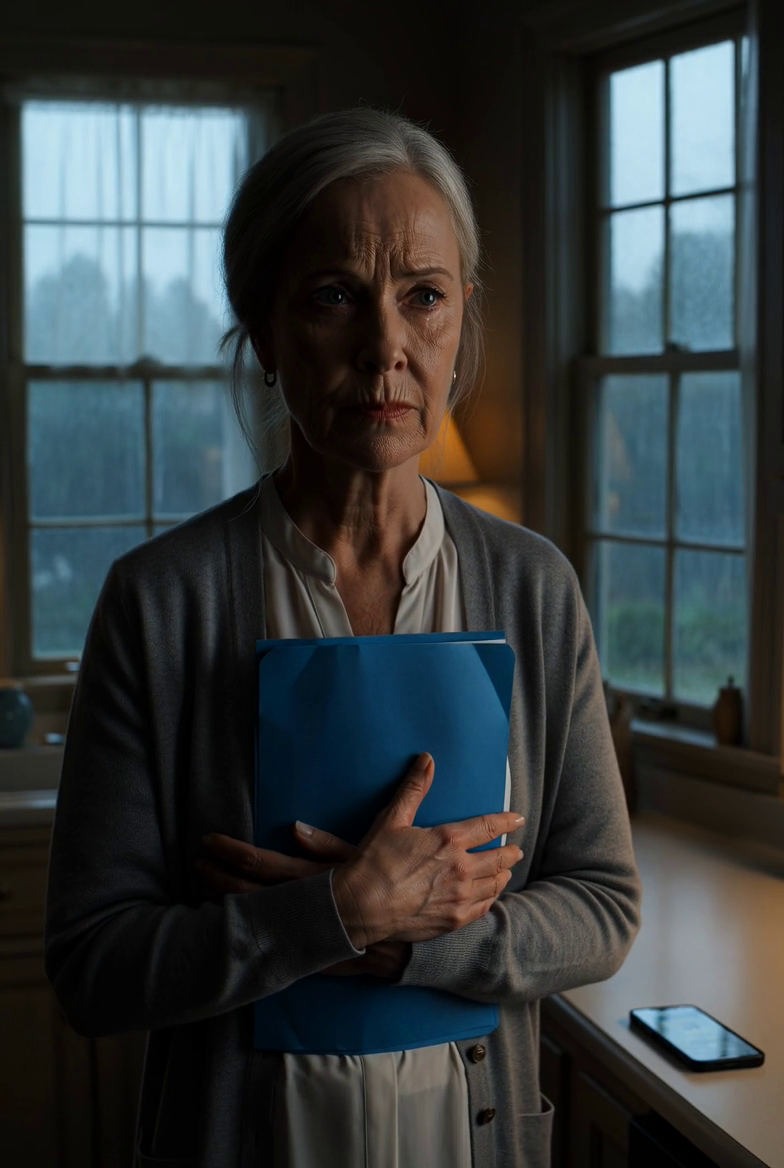
had lived in that house for forty-six years.
The pantry door still had pencil marks showing Wren’s height.
The back steps were uneven because my father, who was a better storyteller than carpenter, had built them himself.
I wasn’t preserving a piece of real estate for its resale value.
I was preserving the one place that had never required me to explain where I belonged.
Wren opened the county recorder’s public website.
The forged deed had been recorded on Friday, one day after the acknowledgment claimed I had signed it.
The notary’s business address appeared beneath the seal.
It was a storefront two blocks from the office of Celia Voss, the woman people were calling Mrs.
Shaw.
“Dad said Celia posed with him because you didn’t want publicity,” Wren confessed.
“I never went to those dinners.
He called her a consultant.
I didn’t know people used our name for her.”
I took her hand.
“You asked questions before you signed.
That’s what matters.”
The following morning we sat with Anika Roy, a civil litigator who handled business and property disputes.
She didn’t promise that a uniform would make a judge believe me.
She didn’t say a photograph of a necklace would win a case.
She read the operating agreement, the recorded deed, the proposed closing schedule, and the documents Wren had received as a member.
Then she asked me for proof of where I had been when the documents were supposedly signed.
I contacted the training office at Fort Riley through the proper channels.
By that afternoon, I had my own dated assignment schedule, the signed attendance roster, and an unclassified photograph taken during the exercise.
I had been at a briefing board with the evaluator’s clock visible in the frame at 2:11 p.m.
An officer who stood beside me agreed to provide a declaration if the court needed one.
Anika sent formal notices to Peter, the company’s counsel, Ridgeline’s lawyers, and the title company, disputing my signature and the land transfer and demanding preservation of the records.
She sought an emergency order to prevent a closing while the court examined the evidence.
It wasn’t a magic switch.
The forged deed still appeared in public records, and my name was still in a deal I hadn’t approved.
But the buyer knew that title was contested, and its closing counsel suspended preparation of the final disbursement.
That evening Peter called eighteen times.
On the nineteenth, I answered.
“Miriam, why did you go to a lawyer?” His voice was low and controlled.
“You could ruin this transaction.”
“Who is Celia?”
“A consultant.
She handles the events.”
“Then why do your employees call her your wife?”
He exhaled.
“It’s a public-relations arrangement.
I should have explained it.”
“And why is she wearing my compass?”
A door closed on his side of the call.
He lowered his voice further.
“You’re making this bigger than it is.”
“My mother’s house was deeded to your company for a dollar last Friday.
Did you sign my name?”
For the first time, he had no answer.
Then he said, “We can discuss this privately.
Don’t drag Wren into it.”
“You already did,” I told him, and ended the call.
The next morning I drove to the farmhouse with Wren.
We had stopped living there full-time during my assignments,