son was fighting to recover.
Now he looked sick.
“Rebecca knew about the pregnancy,” I said.
“How?”
“I left Lucas a voicemail the morning after he disappeared.
I told him I was carrying his child.
I begged him to call me.”
Michael sat silently.
I continued.
“If she had his phone, she heard it.”
He didn’t dispute that possibility.
I was beginning to understand why someone might want a baby to remain invisible.
The idea that my son could be viewed as an obstacle to an inheritance made me physically ill.
But I also knew suspicion wasn’t proof.
So we began collecting evidence.
I provided screenshots of the breakup message and records of my calls.
Michael had preserved paperwork showing the time of Lucas’s hospital admission.
The attorney requested that Rebecca preserve communications and relevant documents, and began considering court action if necessary.
Meanwhile, Lucas’s rehabilitation team agreed to conduct a fresh assessment before his scheduled transfer.
His nurse had noticed that he became distressed whenever the move was discussed.
She believed he understood what was happening but had difficulty expressing himself quickly enough for others to listen.
That afternoon, the rehabilitation physician used a communication board and a series of simple questions to evaluate Lucas’s understanding of his situation.
The results were significant.
Lucas correctly identified his location, understood that Rebecca wanted him transferred, and repeatedly indicated that he wished to remain at the current center.
He also asked for his father.
The team documented his ability to participate in that decision and suspended the transfer while his treatment preferences were reviewed.
Rebecca was furious.
She telephoned Michael six times.
He answered the seventh call with his attorney present.
“You’ve made a terrible mistake,” she told him.
“No,” he replied.
“My mistake was trusting you without asking Lucas what he wanted.”
Two days after giving birth, I was discharged with my healthy son.
Ana helped me adjust his blanket before we left.
“Have you chosen a name?” she asked.
“Mateo,” I answered.
Mateo Rivera.
I wanted my son to carry the name of the person who had stayed with him through every difficult day.
Michael offered to drive us home, but I asked him to take me somewhere else first.
I wanted to see Lucas.
At the rehabilitation center, the smell of disinfectant and warm laundry reminded me of the hospital.
My hands were damp against Mateo’s car seat handle.
I had imagined this meeting a hundred different ways.
Sometimes I pictured Lucas apologizing for leaving us.
Sometimes I imagined screaming at him.
Sometimes I wondered whether I could ever bear to see his face again.
None of those imagined conversations prepared me for the reality.
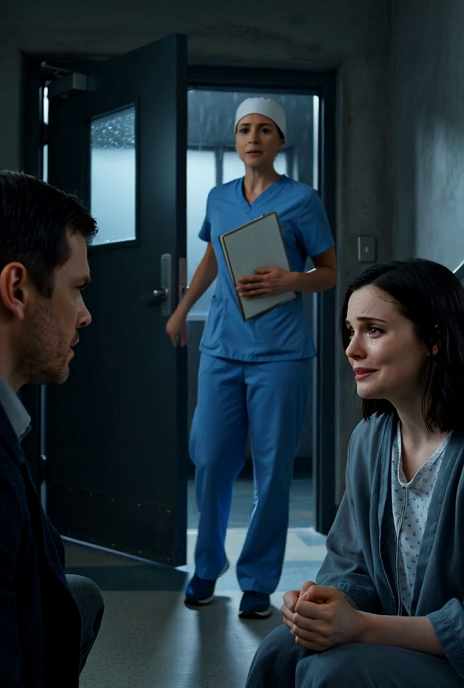
Lucas sat in a wheelchair near a large window.
His left hand rested on the armrest.
His right hand held a soft foam ball used for therapy.
He looked thinner than he had in our apartment, and one side of his body moved with visible effort.
When the door opened, he turned his head.
Our eyes met.
The foam ball fell from his fingers.
“Ca…” he whispered.
He tried again.
“Cami.”
I stopped in the doorway.
“Lucas.”
His eyes filled.
He reached toward me with his stronger hand.
I crossed the room and knelt beside him.
He touched my cheek, as if he