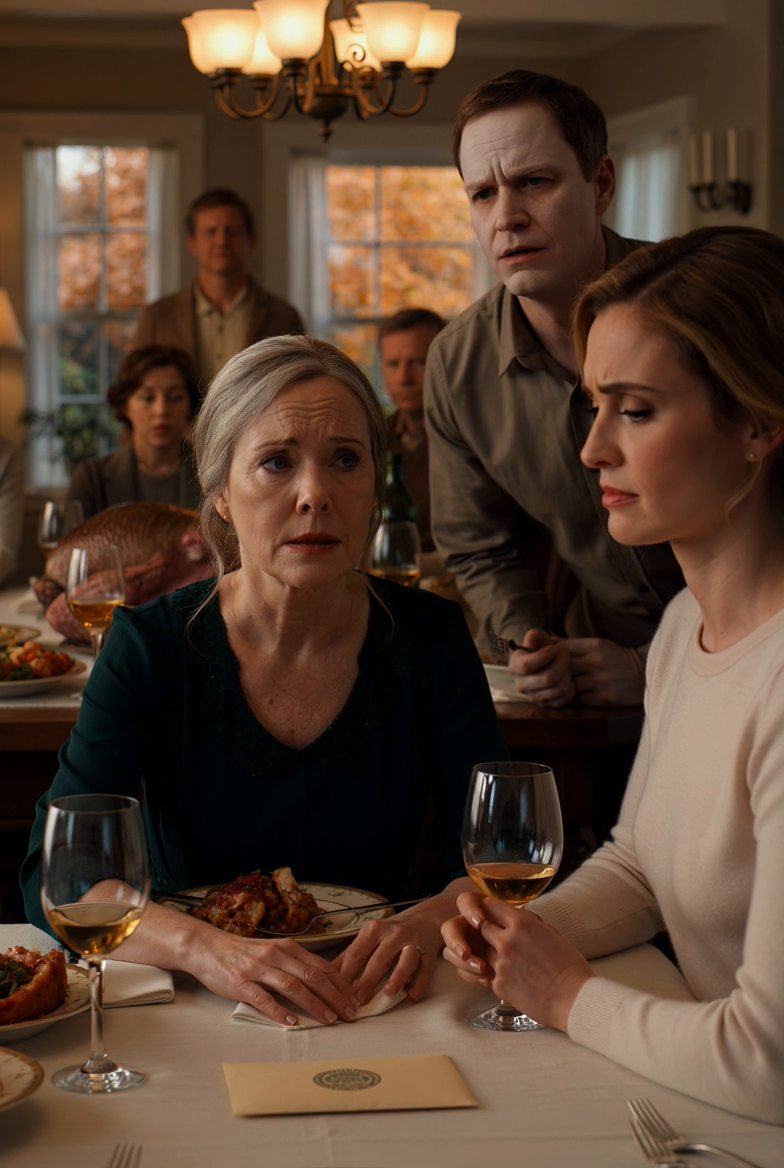
The Christmas tree lights reflected across the living room window, creating a warm picture of a family that looked happy from the outside.
Inside that house, however, one little girl was about to learn that adults could create the deepest wounds with the softest voices.
Mia was six years old and had spent an entire afternoon making a paper snowflake for her grandmother.
She carefully colored every person in the family.
She added tiny details she believed mattered: her brother’s favorite blue sweater, her father’s glasses, her mother’s necklace, and a silver star above Sharon’s head.
To Mia, that star meant one thing.
Love.
To Sharon, it became an opportunity.
The tension had not started that night.
It had been growing quietly for years.
Sharon never openly attacked Mia when other people were watching.
She was smarter than that.
She used small comments, small exclusions, and small reminders that made everyone uncomfortable but gave her room to pretend she had done nothing wrong.
At birthdays, she remembered every grandchild’s favorite cake except Mia’s.
During family pictures, she somehow always placed Mia at the edge.
When gifts were opened, Mia received things chosen quickly while the other children received expensive surprises.
Each incident seemed too small to fight about.
That was exactly why they continued.
Thomas always noticed.
He always promised he would handle it.
But there was always another family event, another argument he wanted to avoid, another reason to wait.
Until Christmas night.
Mia walked across the room carrying her handmade ornament.
The adults watched without realizing how much courage it took for a child to offer something she created with love.
Sharon accepted it between two fingers.
Then she said the sentence that changed everything.
“Children from mommy’s cheating don’t get to call me grandma.”
The room froze.
Mia did not understand the accusation behind the words, but she understood rejection.
Children recognize when love is suddenly removed.
Her smile disappeared.
She looked toward her father.
Thomas looked away.
That moment hurt him more than anyone else in the room because he finally saw what his silence had done.
He had convinced himself that avoiding conflict was protecting his family.
Instead, it had allowed his daughter to stand alone.
Then Noah moved.
He was only eight, but he understood something the adults had forgotten.
Family was not proven by blood alone.
It was proven by who stood beside you when someone tried to make you feel small.
He returned the gift Sharon had given him and took Mia’s hand.
“If she doesn’t have a grandma,” he said, “then I don’t either.”
The words broke something in the room.
Not Mia.
The illusion.
Thomas finally stood.
For years, he had been afraid of upsetting his mother.
He feared family arguments, damaged relationships, and accusations that he was being dramatic.
But watching his daughter search a room full of adults for protection changed his priorities forever.
He stepped forward and reached into his jacket.
Inside was an envelope he had carried for months.
The laboratory seal immediately caught Sharon’s attention.
She knew.
Everyone else realized she knew.
Thomas placed it on the table and told her she should have stopped years earlier.
The envelope contained the answer to the question Sharon had used as a weapon for half a decade.